
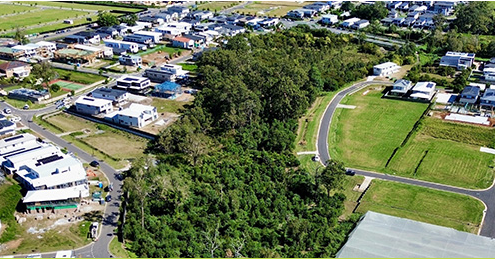
Environmental areas within new residential communities are often designated based on biodiversity value. In many cases, conservation and development can coexist well because high-value environmental areas tend to occur along creeklines, gullies or hilly country that was historically difficult to clear and farm.
Where these natural areas remain intact, it generally makes more economic and environmental sense to preserve them than reconstruct them after clearing. A functional riparian corridor can therefore be a significant asset for a landowner seeking a change of land use that triggers Council or State Government environmental requirements.
These environmental assets can also integrate well into new residential communities. Flood-prone land may already be unsuitable for development yield, while riparian corridors can contribute to community open space, with walking tracks and recreational features incorporated alongside conservation outcomes.
Flood and Natural Event Risks During Rehabilitation
These same areas are often the most exposed to natural events—particularly flooding in low-lying areas and bushfire in hilly or adjoining landscapes. These events can affect built park assets as well as rehabilitation works being undertaken by restoration contractors.
The first two years of a rehabilitation project are typically the most vulnerable. We are attempting an environmental transformation over a relatively short period compared with the decades over which land was converted to productive agriculture. During this transition, a site can be unstable, and a significant natural event can literally erode substantial restoration work.
The challenge is amplified when a weed- or pasture-dominated site is revegetated and set on the path to recovery. Removing unwanted vegetation, including weeds and exotic grasses, temporarily exposes the site. During this window, particularly in flood-prone environments, things can go wrong.
Managing Rehabilitation After a Flood Event
For a landowner, outcome-based performance assessments can be significantly disrupted by flooding—whether high velocity or slow draining. New plantings are particularly vulnerable before roots have established, with scour, silt deposition and prolonged inundation sometimes causing total losses. More advanced plantings can withstand some events, but flooding can still wind back the clock on achieving conformance.
The right erosion-control products and species selection upfront can reduce this risk. Ask your consultant to assess site-specific risks and select product combinations that favour a more resilient outcome. Flow-rated coir matting can help secure mulch in flood-prone zones, while flood-tolerant native species such as Callistemons and Casuarinas can recover well following inundation and coppicing.
Tree guards should also be questioned as an expense in active flood zones. Rapid intervention after an event can sometimes make the difference: exposed roots and silt deposition can be rectified early, potentially saving more established plantings.
Rehabilitation Compliance, Contracts and the Project Team
Having the right project team in place is equally important. An experienced rehabilitation consultant should understand appropriate products and specifications, while also establishing a contract flexible enough to respond to unforeseen site conditions and natural events.
Throughout the project, good record keeping, photographs and evidence become particularly valuable when discussing rehabilitation outcomes with Council inspectors. Following a significant event, engage early, document what occurred and seek a collaborative solution rather than simply waiting for the next compliance assessment.
Councils are often the ultimate asset owner of public open space and therefore have an interest in the project's successful rehabilitation and long-term resilience.
Fortunately, Australian landscapes often retain a strong capacity for natural recovery, which can greatly assist landowners working towards restoration goals. But recovery takes time.
Residential rehabilitation offset
A functional riparian corridor can support biodiversity, flood management and community open space within a new residential development. The project team should plan for early-stage flood risk, flexible rehabilitation contracts and rapid intervention after natural events.
Frequently Asked Questions
Why are the first two years of rehabilitation especially vulnerable?
New plantings have limited root establishment and weed removal can temporarily expose soil, making sites more susceptible to scour, silt deposition, inundation and other natural events.
How can flood risk be reduced in rehabilitation areas?
Assess site-specific risks, use suitable erosion-control products, select flood-tolerant native species, document conditions and intervene quickly after an event.